





- Automotive Spice as a core element to safeguard digital mobility
No function in today's vehicles would be conceivable without software. To make everything operate smoothly, the individual components need to be reliably coordinated. Not only is everything inside a vehicle networked - the on-board systems are increasingly interacting with the external infrastructure as well. Automotive Spice has proven itself internationally as an assessment model and guarantor for the quality of software.
When we get into a car today, we immediately notice that a lot of software is required for all of the displays, assistance systems, lighting, and other features to deliver a safe mobility experience. Software that supports mobility is developed, tested, and integrated by hundreds or even thousands of software developers in various organizations around the globe. It easily runs to more than a hundred million lines of code. This means we are not only dealing with a high level of technical complexity, but a great deal of organizational complexity as well. Legal requirements, for instance regarding the electromagnetic compatibility of the control units, emissions legislation, and cybersecurity also have to be taken into account.
Adhering to the “state of the art" demanded in product liability law in all development steps is of crucial importance for the quality of automotive software. Software-based systems with a range of functions that, in essence, are founded on programmed logic or machine-learned behavior, are developed within the framework of extensive standards. Each standard employs a certain approach to pursue a specific goal. Assigning standards to three classes is helpful to obtain a better understanding of these approaches and goals:
Quality management systems (QMS): These are generally implemented in an organization and also reviewed for this organization. The goal of a QMS is the continuous improvement of business performance. To this end, a QMS pursues a top-down approach. Based on the corresponding QM system standard, a framework of resources and procedures is defined and implemented in the organization. A QMS is primarily aimed at the organization's quality management employees. Many quality management systems are based on the ISO 9001 standard. The worldwide established QM system standard for the automotive sector is IATF16949.
Technical standards: These are mainly aimed at product development. Specific requirements for the development and design of a product are defined here. ISO 26262 for functional safety and ISO 21434 for cybersecurity are examples of technical standards in the automotive sector. In many cases, the goal of a technical standard is to minimize specific product risks through specific requirements. A technical standard can decidedly describe the “how” as well, meaning it explicitly specifies a technical solution. Standards for the electrical safety of high-voltage installations in e-mobility are an example. That being said, many technical standards also cover process aspects, that is, the question of “what” in general needs to be done.
Process reference and assessment models: Automotive Spice belongs to the class of process reference and assessment models (evaluation models). Basic practices and the core content of corresponding work products are defined for certain developments, for each individual process (e.g.: requirements management or software testing), and these are then evaluated. Thus Automotive Spice is fundamentally assigned to the “what” level. The goal of such a model is to identify weaknesses and potential improvements in order to ultimately avoid defects in the developed product. Thus the model is aimed at the persons responsible for the respective processes in the first step. Comprehensive project planning, quality assurance of the work results, and anchoring the implementation in the organization then become relevant at higher levels of maturity. Automotive Spice therefore pursues a bottom-up approach.
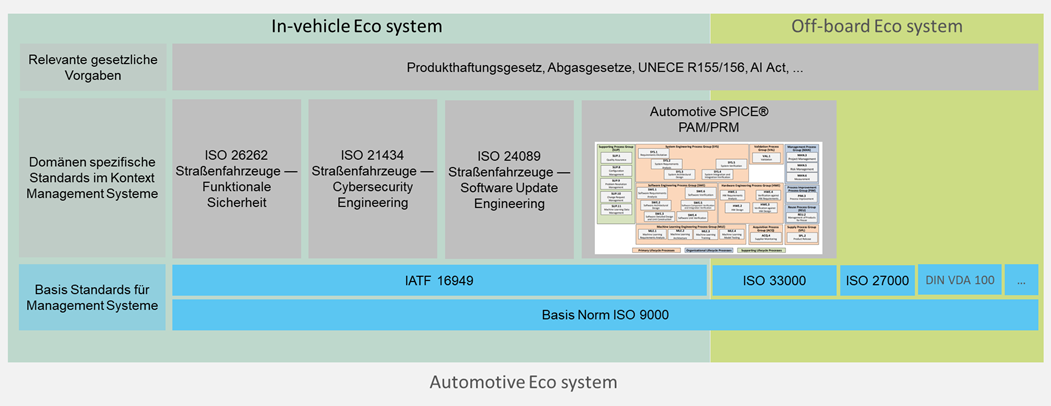
Standardization in the context of Automotive Spice. © VDA QMC / Hanser
In order to guarantee the quality, safety, and reliability of a networked vehicle during its life cycle, observing and implementing the relevant norms and standards for these three classes is indispensable. IATF 16949 with its comprehensive QMS that covers all aspects of automotive production is the integrated concept for the quality of automotive products. The structure of IATF16949 corresponds to the QM standard ISO9001, supplemented by content specific to the automotive sector. Special emphasis is placed on assessing the quality of software development processes.
Automotive Spice begins with the establishment of the supply chain and accompanies development throughout the entire product life cycle. It focuses on classic software and electronics development as well as topics such as safeguarding data-based functions, machine learning, and cybersecurity aspects. The model is not limited to the classic control units installed in the vehicle but can also be applied to external systems such as charging stations.
The quality of software is determined by its development process. In the course of advancing digitalization of the vehicle and its networking with the surrounding infrastructure, avoiding systematic errors at the start and in the course of development is essential for quality, safety, and reliability. Once a new vehicle model has been developed and is ready to be launched in the market, it is usually too late for the correction of errors with regard to a software-based system. Possible consequences include delaying the announced market launch, low customer satisfaction due to unidentified errors, or safety risks for the end user. A QMS, adhering to technical standards, and development support with Automotive Spice are therefore key prerequisites for the success of new models.
International success story of Automotive Spice
The German Association of the Automotive Industry (VDA) established the direction for the quality assurance of software-based systems in and around the vehicle with its recommendation for the use of the Automotive Spice assessment model in 2006. Meanwhile the model is internationally established as a fixed element in the development of digital mobility. Currently more than 7,500 assessors certified by the VDA QMC are directly involved in implementing the standard around the world. This extensive spread to more than 50 countries proves that companies have followed the VDA's recommendation and integrated Automotive Spice into their process landscape and the supply chain.
While the development and advancement of Automotive Spice was primarily driven by German OEMs in the early 2000s, it has become established as a recognized international standard with users on all five continents today. A rapid spread in Asian regions has been observed over the last ten years. The Chinese automotive industry in particular, with currently around 1,500 assessors, is embracing Automotive Spice - with a rising trend.
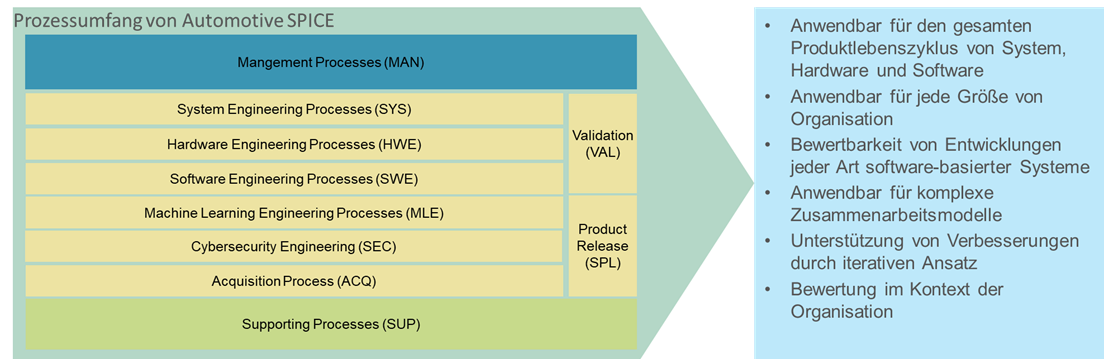
Coverage of relevant topics by Automotive Spice. © VDA QMC / Hanser
Coverage of relevant topics by Automotive Spice
The functionality of a vehicle is developed by means of numerous technical and non-technical processes. In doing so, the Automotive Spice model examines all topics that are not adequately covered by an existing QMS. Examining and assessing the respective processes is not fundamentally limited to a certain phase of the product life cycle. While the classic application to software and hardware elements during development of the overall vehicle is possible, centrally developed software components or also software elements provided to the end customer over the air (data transmission via mobile network) after delivery of the vehicle can also be considered.
As a VDA standard, Automotive Spice is subject to continuous further development by an expert committee of the German Association of the Automotive Industry (VDA) and regularly adapted to the needs of the automotive sector. Thus there is a focus on current topics pertaining to the ongoing maintenance and updating of software after delivery of the vehicle to the customer. This work is done by an international network of experienced automotive industry experts.
Conclusion
Reliability and planning certainty are essential for the automotive industry. This applies in particular to standardization pertaining to the development of vehicle-specific software. A globally established framework consisting of a QMS, international norms, and industry-specific standards establishes the conditions that are needed to efficiently surmount the numerous challenges now and in the future.
Anchored in the internationally recognized QMS IATF16949 and embedded in a number of technical and vehicle-specific ISO standards, Automotive Spice endures as the recommendation of the VDA and its members for safe-guarding digital mobility.
# Article of Automotive SPICE® on QZ Magazine 2024 Dec. version
www.qz-online.de
Authors
Heinz Günter Plegniere, Head of VDA QMC
Dr. Jan Morenzin, Head of Automotive SPICE, VDA QMC
Albrecht Wlokka, Head of ASPICE working group in the VDA QMC / Software Quality Expert at Robert Bosch GmbH
More information: https://vda-qmc.de/en/automotive-spice